A new EU-wide analysis shows that rooftop solar photovoltaics could supply around 40% of Europe’s electricity by 2050. If fully developed, it is projected to provide approximately 40% of the EU's electricity demand by 2050, playing a key role in achieving the long-term goal of a zero-emission energy system.
This study, based on the EU's newly released Digital Building Stock Model (DBSM R2025) and combined with national building administration data, conducted an assessment of rooftop PV potential at the individual building level. This is the first authoritative analysis to date that separately estimates the rooftop PV potential of residential and non-residential buildings within the EU.
The study finds a total potential EU rooftop PV capacity of approximately 2.3 TWp, broken down as follows:
-Residential buildings: ~1,800 GWp
-Non-residential buildings: ~500 GWp
If fully used, this could generate around 2,750 TWh per year, equivalent to about 40% of electricity demand in a 100% renewable EU energy system by 2050.
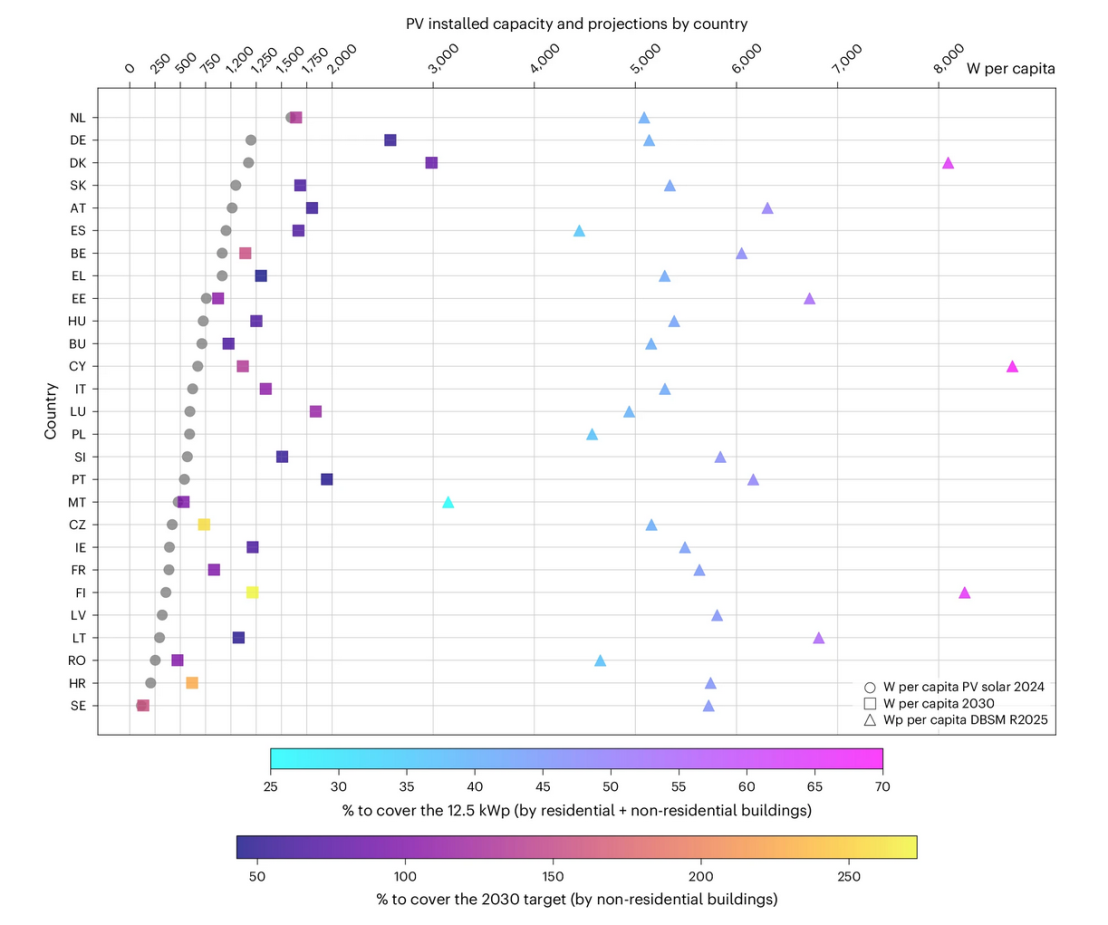
Research shows that by 2030, non-residential rooftop PV installations alone could meet more than half of the EU’s 700 GW solar capacity target. Large buildings with roof areas exceeding 2,000 m² could potentially host around 355 GW of capacity.
In several Member States, including Cyprus, Finland, and Denmark, the potential of non-residential rooftop PV could meet 95% or more of the national PV targets set in the National Energy and Climate Plans (NECPs 2021–2030). If the full rooftop PV potential were utilized, the installed capacity would exceed the solar capacity required under multiple 2050 net-zero scenarios.
A Major Untapped Opportunity for Rooftop Solar
Despite its vast potential, only around 10% of building rooftops across the EU are currently equipped with PV systems. However, these distributed installations already account for approximately 61% of the EU’s total installed solar capacity (339 GWp as of 2024), highlighting the central role of distributed PV in the energy transition.
The building sector is responsible for approximately 42% of the EU’s total energy consumption and 36% of energy-related greenhouse gas emissions, making it a critical focus for achieving climate targets. Yet household electrification across the EU remains at only about 26% (Eurostat data), indicating significant room for further decarbonization and electrification.
As most of today’s building stock is expected to remain in use through 2050, integrating rooftop PV into renovation and upgrade projects represents a powerful opportunity to reduce carbon emissions and lower energy costs. It can also support electrification technologies such as heat pumps and electric vehicle charging. Furthermore, the solar mandate under the Energy Performance of Buildings Directive will accelerate the deployment of solar installations in both new and renovated residential and non-residential buildings, driving wider adoption of rooftop solar across Europe.