Africa's solar sector continued to expand in the first quarter of 2026, with South Africa and Egypt remaining the continent's primary growth markets for new solar installations.
According to the African Solar Industry Association (AFSIA), Morocco, Nigeria, Zambia, and Namibia also recorded notable progress during the quarter, reflecting increasing solar development activity across multiple regions of the continent.
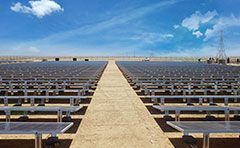
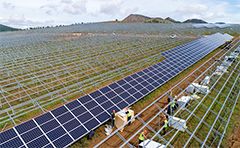
Benjamin Clarke, Operations Director of AFSIA, stated that Africa's utility-scale solar project pipeline has now reached nearly 133GW. The figure underscores the growing interest from developers and investors in the region's renewable energy sector.
Despite the substantial pipeline, Clarke noted that many projects remain in the early stages of development and currently lack a clear pathway to financial close. He emphasized that the challenge facing the industry is no longer the availability of projects, but whether individual markets can provide sufficient grid capacity, policy certainty, and financing mechanisms to support large-scale deployment.
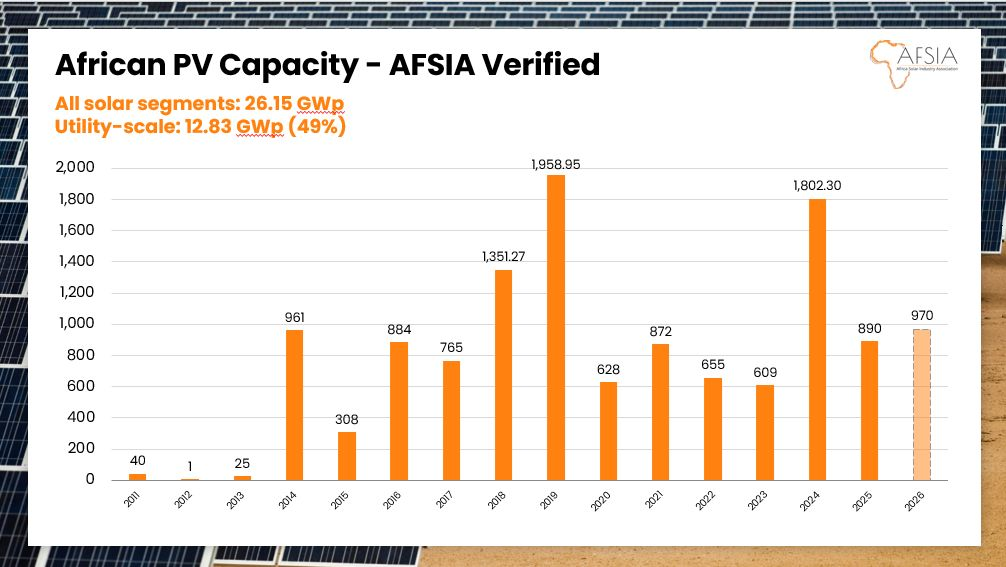
According to AFSIA's Africa Solar Outlook 2026, Africa's cumulative installed and operational solar capacity reached 23.4GW by the end of 2025. Continued investment in energy infrastructure, together with increasing electricity demand and decarbonization goals, is expected to support further growth of the solar sector across the continent.
As Africa advances its renewable energy transition, the development of bankable projects, grid modernization, and stable regulatory frameworks will play a crucial role in transforming the continent's extensive project pipeline into operational solar capacity.